• Home
  • Intro/History
    • Introduction
    • History
    • CHC
    • In Memory
  • Comms
    • Buntings
    • Sparkers
    • Submariners
    • WRNS
  • General
    • Port
    • Midships
    • Starboard
  • HMS
    • Various
    • Mercury
    • Ganges
  • Restoration
    • Awaiting Restoration
    • Restored Equipment
  • Photographs
  • Books/Publications
    • Publications
    • The Communicator
    • Personal
  • Bits & Bobs
    • Search
    • Contacts
    • Links
    • Radars & Navaids


SLIP READER

Written by anon

©RN Communications Branch Museum/Library
(Click on an image to enlarge)


  There is often a lot of discussion regarding the speed of Morse that can be read by an operator. Generally, operators were trained to read Morse to a spee of between 18 and and 25 wpm. Occasionally, some operators, those with a particular skill could read up to 35 wpm. However, much above this speed is a rarity and speeds of 60+wpm is unheard of. The term 'read' means being able to listen to the Morse code and transcribe it into plain language and write it down.


  As can be seen from Project Undulator the undulator can transmit Morse at speeds of circa 250 wpm. At these much higher speeds it is easier to read the Morse code from a paper tape (produced by the undulator) and manually transcribe the Morse into plain language.


  To read Morse by ear: Each character takes a different time span. A dot (.) is 1 unit long whereas a dash (-) is 3 units long. The letter E "." is one unit whereas the letter Q "--.-" is 10 units, so takes 10 times as long to send/receive. In addition, spaces between characters and words add to the time. Also, the receiving operator has no control over the speed of the incoming signal so rarely works at maximum ability.


  Words Per Minute (wpm) is the term used to measure the speed at which Morse code is sent or received by an operator. The traditional method is to use 5 characters for a word. This makes coded meassage containing blocks of 5 characters easy to calculate. 40 blocks (200 caracters) in 1 minute is 40 wpm.


  The Slip Reader is quite different. The slip with Morse code printed on it is pulled in front of the operator using foot pedal control. The operator recognises each Morse symbol as a character and immediately types this out onto a typewriter. Each character is the same length and spaces are recognised and typed using the typewriter space bar. The operator can vary the speed that the slip is pulled through and can work at maximum ability and at speeds above 40 wpm.


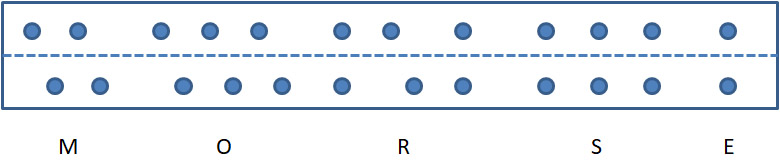
  To transmit a message at high speed a different type of paper tape had to be created. The characters to be transmitted were coverted to Morse code in a two unit format and stored as punched hole tapes. This was done using a perforator which generated a tape similar to that shown below. This tape is fed into a Wheatstone Transmitter that converts the holes into dots and dashed. The Wheatstone Transmitter operates exactly like a 'hand Morse key'. The transmitter can be altered to speeds varying from 6 wpm to 250 wpm.


  The two unit tape has small holes down the middle for a sprocket wheel to feed the tape through a tape reader. A dot has two holes punched in the tape, one either side of the of the sprocket holes. A dash has one hole above the sprocket and then a hole below the NEXT sprocket.